A UX Designer | Product Designer | Interaction Designer.


A one-stop solution for Digital Production Factories, enabling secure and seamless data transfer across the production lifecycle. Designed to streamline collaboration across production lines and manufacturing stations while ensuring security, visibility, traceability, and compliance.
Timeline:
8 Weeks Client Project
My Role:
UI & UX Designer
Deliverables:
•Information Architecture • User Stories • Process Mapping • Enhanced User Flows • Wireframing • Visual Design • Interactive Prototype • Design System Integration • Usability Validation • Developer Handoff
Project Overview
Core Business Problem were solving
In manufacturing Industries, a single outdated file can trigger production delays, compliance failures, and expensive rework. As operations grow more dependent on digital collaboration across factories, vendors, and production teams, securely transferring and managing production-critical documents has become a core operational requirement.
However, many teams still depend on manual methods such as USB drives, emails, and shared folders to exchange sensitive production data. These fragmented workflows often result in data security risks, malware vulnerabilities, version mismatches, unclear audit trails, and delays throughout the product lifecycle.
Citadel was designed to address these challenges by providing a secure and transparent platform for managing production documents. By enabling teams to upload, track, approve, and share files through a centralized system, Citadel improves visibility, governance, and collaboration, ensuring the right information reaches the right stakeholders at the right time.

Business Objective
Establish Citadel as a centralized, secure, cloud-based platform for managing data transfer across digital product factories. The following are non-negotiable core requirements:
-
Uncompromising security: Security standards must never be reduced under any circumstances.
-
Faster file transfers: Enable rapid, reliable file movement through a cloud-based application.
-
Complete audit tracking: Capture an audit trail for every single file upload.
-
Full user activity monitoring: Track every user action across the platform.
Design Process

Research and Discovery Phase
Project Kickoff & Stakeholder Alignment
To set the foundation for Citadel’s, I facilitated a cross-functional kickoff workshop with stakeholders , PMs and subject matter experts. Our objective was to align on business goals, user challenges, and Technical Constrains that impact digital product factories. This involves gathering all Product information and user data to identifying user problems through multiple calls and sittings with stakeholders.
" Conducted Cross Functional Workshops "

Identified Challenges

Data security risks, Malware Vulnerabilities, Version mismatches, and Unclear audit trails.
Overloaded interfaces and screens, Performance issues and Repetitive workflows.
- Stakeholders
- SME (subject matter expert)
To avoid premature design solutions I reframed the given feedbacks as a working hypothesis. This ensured our focus remained on uncovering root causes through research-driven insights.
Phase 1 : Quantitative Research Insights
We conducted quantitative research to uncover foundational patterns in our users’ demographics, roles, technical proficiency, and workflow behaviors within manufacturing environments.
Our goal was to validate user characteristics at scale and establish a strong baseline before diving deeper into qualitative studies.


Phase 2 : Qualitative Research Outcome
Conducted a Cross Functional Workshops by remote user interviews with Users in Citadel environment, including custom manufacturers, vendors, and production managers and SME's, to gather insights in their environment with their experiences, challenges, and expectations regarding citadel. These interactions helped in gaining insights for collecting user needs & pain points, and Feature expectations.

Users helped us understand the Personas their Workflows, user Needs & Pain Points

We tested the existing Citadel experience to benchmark usability to identify citadel workflow frictions.
Participants
Product Managers
Custom Manufacturers
Vendors
Engineers
Area of Expertise
Station-level file sharing, Providing Access
Station-level file sharing, live operations
Station-level file sharing,External access, permission setup
Version tracking, file review, internal QA
Tasks Observed :
-
Upload a file and assign it to a station
-
Share with a vendor securely and adjust permissions
-
Confirm version history and view activity log
-
Access recently uploaded files
-
Approve a file for factory-wide use
How did we plan to measure the success of these goals ?
-
Related Navigation Issues : We Reduced the Number of Clicks & Task completion Rate to complete a Task
-
Cognitive Load : We redesigned the form completion by 2x Speed by adding hover tooltips, skipping optional fields , providing Auto-suggestions.
"Let's Understand how we Measured Navigation Issues"
Before Citadel

-
Total Number of Clicks : 12 + Clicks
-
Total time Taken : 15 mins
-
Wait Time : 10 mins to 20 mins ( Getting Approvals & Permissions )
After Citadel

-
Total Number of Clicks : 6 Clicks
-
Total time Taken : 3 mins
-
Wait Time : 05 mins
" Let's Understand how we measured Cognitive Load "
-
During User Research, we asked vendor, to finish the File upload process for selected product to a specific station. We observed that our user navigating the an upload form, which included fields like:
-
DRI
-
Line Server
-
Operation Reference ID
-
-
What We Observed
-
Priya paused for 5–7 seconds at each unknown field.
-
She eventually skipped DRI and Line Server.
-

These terms required domain knowledge, which vendors didn't have.
" Well, I’ve seen this before, but no one ever explained what to put here. I just leave it blank "

-
We redesigned the form completion by 2x Speed.
-
Progressive Disclosure
-
Advanced Filtering
-
Adding tooltips
-
Skipping optional fields
-
Providing Auto-suggestions.
-
User Problems

Affinity Mapping

Refined Problem Statement
Citadel’s current design creates significant cognitive overload for users due to its complex navigation, redundant steps, and unclear workflows. As a result, expert users face delays in critical tasks such as uploading, sharing, and verifying files leading to reduced trust, slower collaboration, and low system confidence in digital product factories.
Goals
The goal are set to:
-
Reduce cognitive load by simplifying the information hierarchy and task flows
-
Streamline navigation and eliminate unnecessary steps across workflows
-
Make the platform intuitive and minimalistic, without compromising its secure architecture
-
Increase transparency and confidence in file uploads, version control, and station assignments
-
Make users feel Secure and Safe across the Platform.
Strategy
User Persona
We Captured 2 User Groups
-
Production Manager working in Production Units
-
Vendors who are from Different Stations
Nitty-Gritty Differences We observed

Through User Personas, We outlined the User Demographics such as Age Groups, Workflows, characteristics, goals, and pain points.
Each persona was further detailed to understand Users behaviour, emotions, through Empathy to better understand how users interact within system and make informed design decisions.
-
We captured the user’s roles, context, user goals & real-world needs.
-
Also a quick day-in-the-life snapshot to understand User Workflows and pain points.
-
we also include their tech familiarity, and device preferences to design seamless cross-platform experiences.
-
we focus on their mental models and decision-making patterns to ensures the interface feels intuitive with cognitive alignment.
-
we also consider accessibility needs, trust factors, and behavioral patterns to ensure the design feels inclusive and intuitive.
Production Manager Persona

Vendor Persona

Use Cases

User Flows for Admin Case and Vendor Case


Solution Design
Low-Fedility Wireframes
Version 1

Feedbacks Received
Keep It Simple
Read Less | Scan More | Consistent Flow
Minimalistic Design
Simplified Layout | More Functionality
Citadel
Use of Existing Patterns
Visuals | Icons | Typos | White spacing
Simplified workflow
Intuitive interfaces | Creative
Deliverable Screens
Admin Screens
-
Home Page :
-
User Management Page :
-
History Page :
Product ListView | Station Listview | Station Page | Upload File Process
Vendor Listview | Vendor Profile View | Assign / Disable Station to vendor
Admin Activities | Upload File History | View all files
Vendor Screens
-
Home Page :
Product ListView | Station Listview | Station Page | Upload File Process
-
History Page :
Admin Activities | Upload File History | View all files
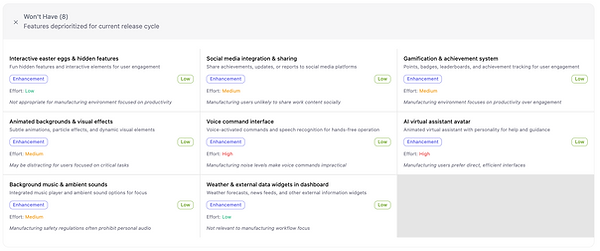
MoSCoW Feature Prioritization Matrix


Version 2

Style Guide


Design decisions
Allow vendors/admins to quickly choose the product line they are working on (e.g., D49, D50).
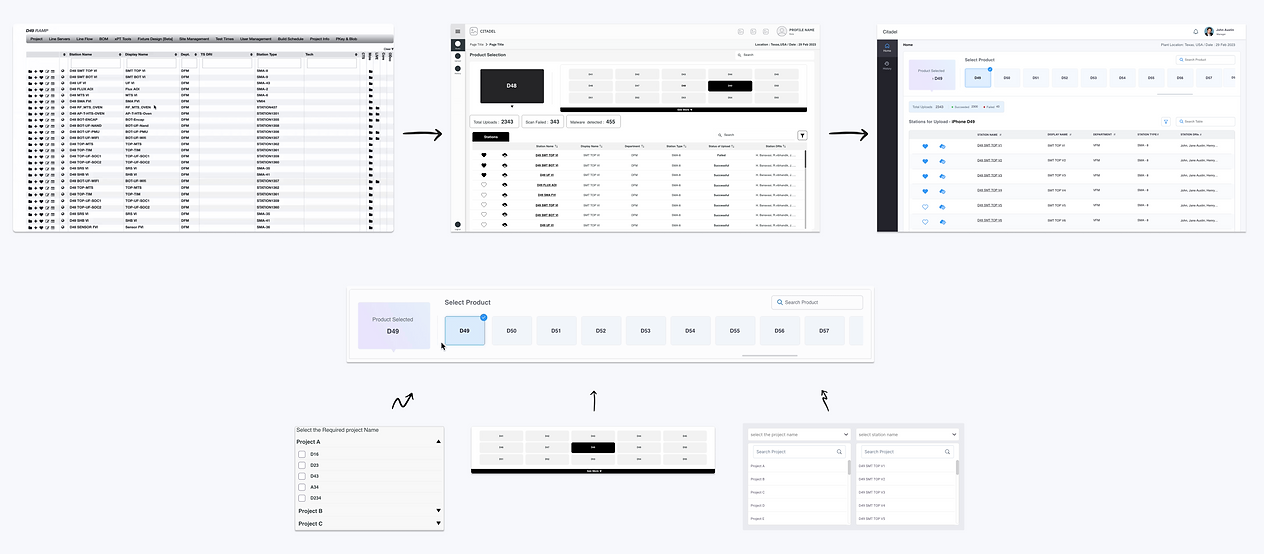

Why Product Cards Instead of Dropdowns
-
One-tap access via rails is faster than dropdown.
-
Product rails display all stations related to product, allowing users to see what's available without interaction.
-
In contrast, dropdowns require user effort to open and browse a cognitive and interaction step that can slow users down
Allow vendors/admins to quickly choose the Station and add to favourites that they are working
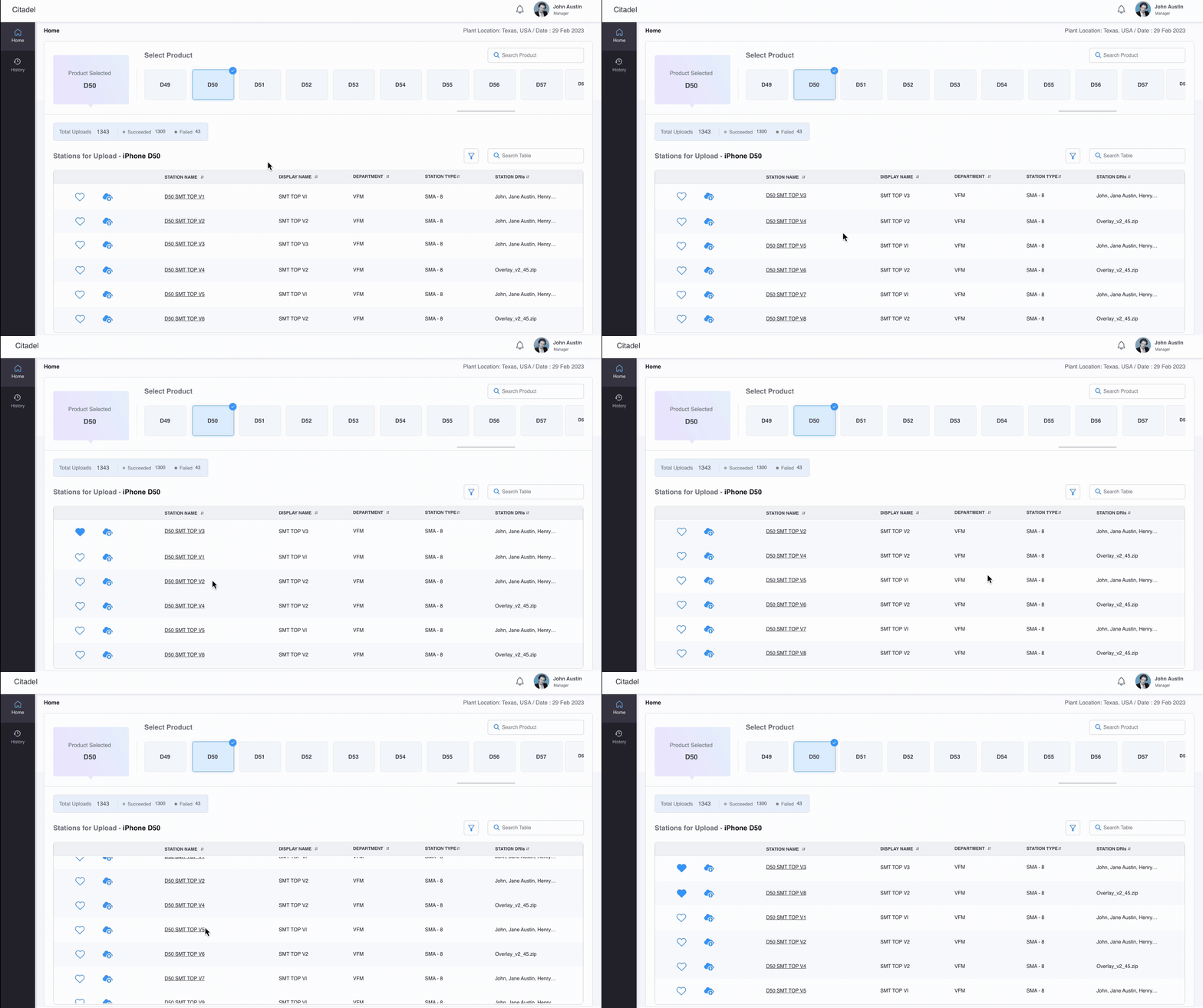
Vendors and admins often work with multiple stations and need to switch between them quickly. Searching or scrolling stations every time slows them down and increases friction. By allowing users to mark frequently used stations as favorites, we reduce navigation steps, speed up workflows, and minimize cognitive load — making the overall experience faster and more intuitive.
Allow Vendors/admins to quickly Upload file and add Meta data fields
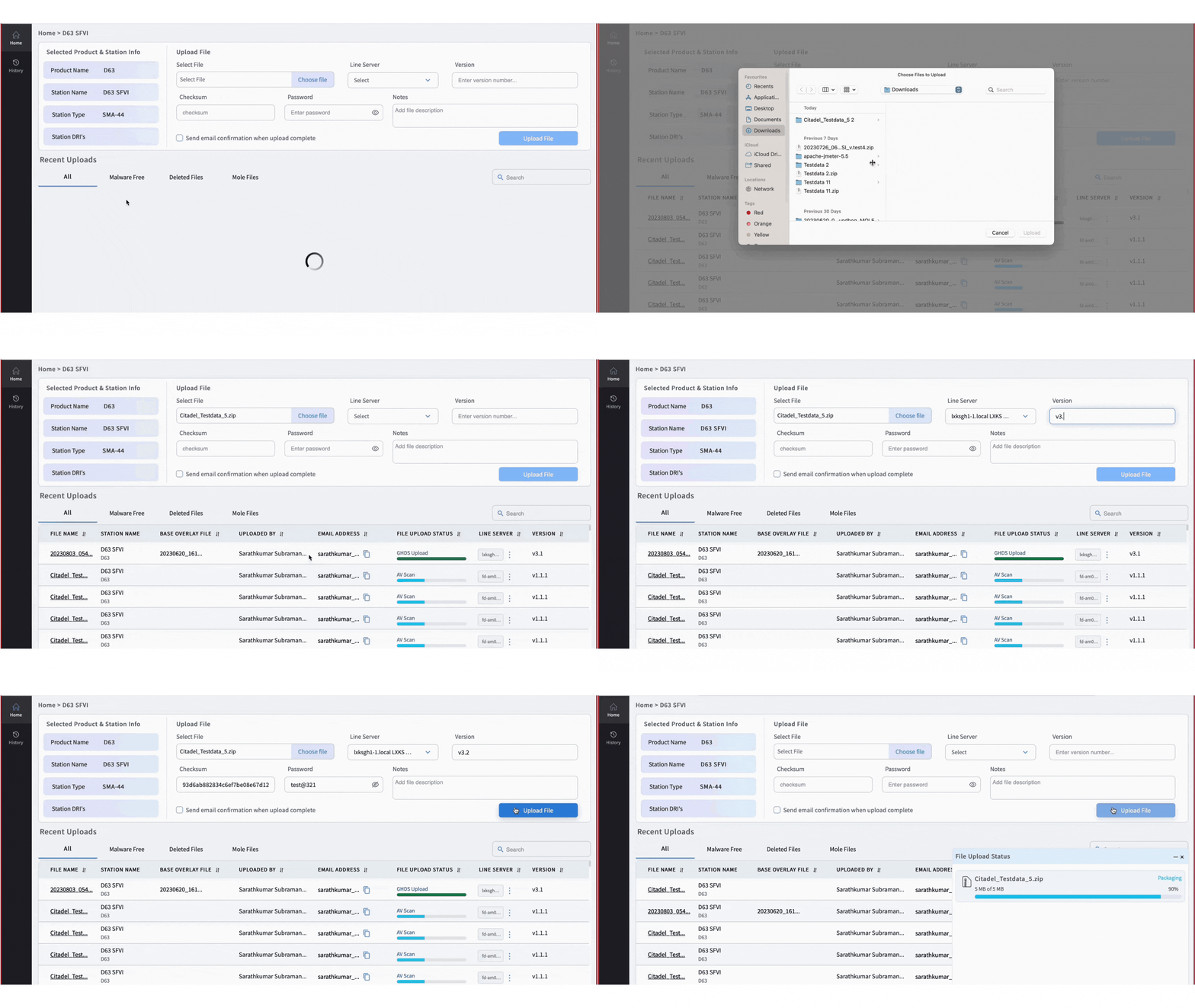
we split the file upload flow into 3 steps to reduce cognitive overload and progressive disclosures. By guiding users in step-by-step which reduced errors, and gave them clearer feedback along the way.
Final UI Screens

Conclusion Statement :
By reimagining Citadel’s user experience, we delivered a solution that not only met our core objectives but drove substantial, measurable improvements based on our Usability Report.

For more details Visit here:
https://www.notion.so/Citadel-User-Experience-Testing-Report-1ee8e24caa4f802ea6f9e39ee65702a8?pvs=4
Achievements
I am honored to receive the Spotlight Award in acknowledgment of my exceptional performance in successfully completing the project within the designated timeframe


